Perspectives on Markets and War
History argues strongly in favor of selling geopolitical risk premiums once hostilities begin, as markets have historically delivered favorable forward returns more often than not after the initial shock. Buying equities at the onset of major conflicts has produced positive outcomes in roughly 68% of cases 1 month forward, 62% over 6 months, and 71% over a 1-year horizon, reflecting markets’ tendency to recover as uncertainty fades and risk is repriced. That recovery path, however, depends on how the conflict is ultimately perceived.
Here are the historical patterns:
- Day 1 Impact: S&P 500 typically drops 1-5% on first trading day, with peak volatility in opening hours
- Week 1 Recovery: Markets often recover 50-70% of initial losses within 5 trading days if conflict appears contained
- Month 1 Trajectory: Positive returns in 60% of historical cases as uncertainty premium dissipates
- 6-Month Performance: Median S&P 500 return of +8-12% as defense spending multipliers take effect
- 1-Year Outlook: War premium fully priced; returns driven by macroeconomic fundamentals
Case Study 1: The Gulf War
Iraq invaded Kuwait on Thursday, August 2, 1990. The initial market decline following the invasion accelerated over the subsequent weeks as recession fears intensified and investor confidence deteriorated. At the same time, oil prices doubled from roughly $20 to $40 per barrel, further undermining consumer sentiment and amplifying macroeconomic stress. These pressures ultimately drove the S&P 500 to a trough in October 1990, marking a peak-to-trough decline of approximately 17% from pre-invasion levels. Volatility surged alongside the selloff, with the VIX jumping from 18 to 36 within the first two weeks, reflecting a sharp rise in uncertainty and risk aversion.
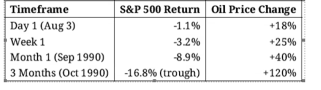
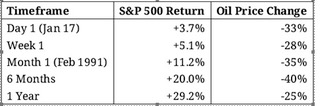
Looking at Operation Desert Storm, which received congressional authorization on January 12, 1991, and the launch of the air campaign on January 16, Operation Desert Storm rapidly removed uncertainty, triggering a powerful relief rally across markets. Oil prices collapsed from roughly $40 to $20 per barrel within 48 hours as fears of supply disruption evaporated, reversing one of the key macro headwinds. Equities responded forcefully: the Dow surged 17% in the first 4 weeks of the campaign, and from the start of air operations through the June 8, 1991 victory parade, the S&P 500 gained approximately 20% while the Dow rose 18.6%, underscoring how clarity on conflict trajectory can overwhelm prior risk premiums:
Case Study 2: Iraq War of March 2003
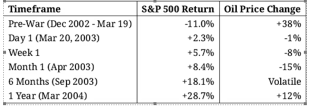
In the lead-up to the Iraq War, markets began pricing in the probability of conflict as early as late 2002, producing an unusual anticipatory sell-off ahead of the first shots. When the war officially began, that uncertainty was lifted, triggering an immediate relief rally consistent with a classic “sell the rumor, buy the news” dynamic. Oil prices, which had risen roughly 38% from $18 to $25 per barrel during the buildup phase, stabilized as fears of prolonged supply disruption eased. Rapid early military advances reinforced expectations of a short conflict, supporting a swift recovery narrative, and despite ongoing geopolitical uncertainty, the S&P 500 finished the 2003 calendar year up approximately 29%.
Case Study 3: Russia-Ukraine Invasion on February 24th, 2022
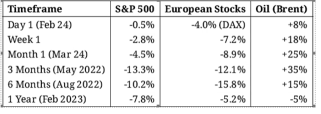
When Russia invaded Ukraine on February 24, 2022, U.S. markets were open and proved relatively resilient, with the S&P 500 down only 0.5% on the day, while European markets suffered significantly larger losses due to their heavy dependence on Russian energy. Brent crude prices surged rapidly, topping $110 per barrel by March 2 as supply risks intensified. Russian financial markets experienced extreme dislocation: the MOEX Index plunged 39% on the first day, rebounded 26% on the second, and was then closed indefinitely. Geographic proximity to the conflict created pronounced asymmetric risk, leaving European banks, energy companies, and industrial firms far more exposed than their U.S. counterparts.
***
We think the primary market risk is related to closure of the straits of Hormuz and the potential destruction of Middle East energy infrastructure. As you know, we have worried about the risk of higher energy prices and their impact on inflation. As a result, our portfolios have been significantly overweight energy stocks relative to the S&P 500. We continue to have a core position in gold and gold equities because of heightened geopolitical risk, inflation risk and de-dollarization.
If you have any questions, please reach out.